
Those who Save Lives: Kevin Briggs

The Golden Gate Bridge in San Francisco has numerous claims to fame. Once the longest suspension bridge in the world, and still probably the most iconic, it’s a central feature of the SF Bay Area — my own home.

Less admirable is the fact that it remains among the most popular bridges in the nation for suicidal people to jump from. In fact, it’s one of the most “utilized” suicide spots in the entire world, with over 1,600 jumps made so far, most of them fatal. (Exact numbers are hard to come by for a good reason: bridge administrators and media outlets stopped keeping an official tally when they realized it was incentivizing people to ring in big milestones with their own attempts — lucky number 1,000 and so forth.) Someone still tries to jump about once every two weeks, which sounds insane, but is true.

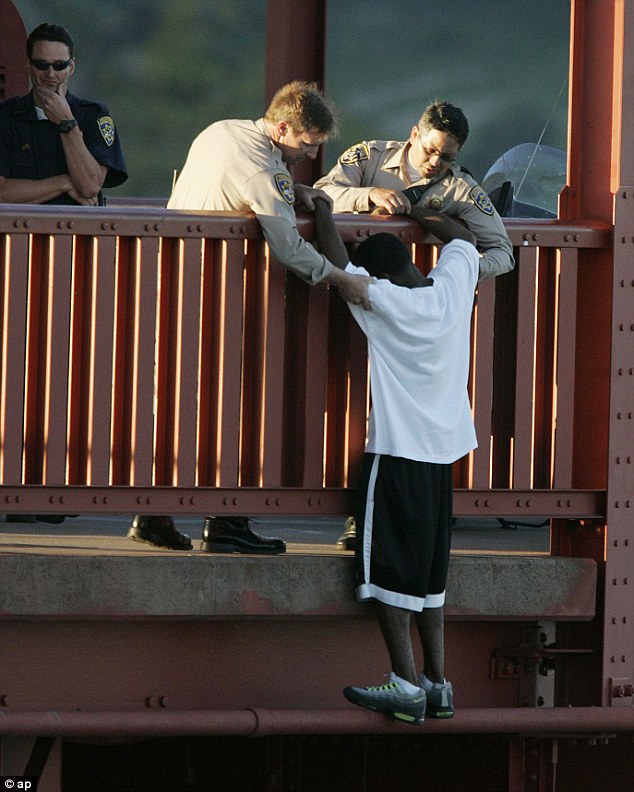
Sergeant Kevin Briggs was a California Highway Patrol officer who spent a large part of his career patrolling that same bridge, which led to an interesting twist on his job description: suicide prevention. See, often times he was the one to notice a pedestrian who looked like they were considering jumping, or were even in the process of climbing over the rail. Sometimes he’d be called in by others who saw it first. Jumpers tended to stand on the “chord,” a ledge of piping just beyond the safety rail and the last solid ground before open air. Kevin would talk to them there, and try to convince them it was a bad idea.

It wasn’t something he had any training to do, at least not at first, or experience with, although he picked that up quickly. He had suicide in his family — as many of us do, since it’s incredibly common — but otherwise, he fell into the role the way many of us fall into our callings. Eventually, he made it his niche, leading a trained team of interveners.

Over the years, he spoke to hundreds of jumpers. At first, he’d approach benignly — “How are you feeling today?” and “What’s your plan for tomorrow?” For those without plans, he’d help them make some, because people with a plan tended to stick around to fulfill it.

Later, he became more direct, asking up front whether they’d come to hurt themselves. Or the simple question: “Others in similar circumstances have thought about ending their life. Have you had these thoughts?”

Either way, the encounters tended to unfold similarly. And as a rule, they went well. Of the countless desperate people he met, only two ended up jumping once he’d managed to make contact.

The jumpers met the pattern recognized by psychiatry as comprising the depressed and suicidal. They exhibited hopelessness — the outlook that things are terrible and will never get better. Most of us can ride out terrible storms, but if there’s no prospect of the storm ever ending, why bother? (“What do you do,” asked one, “when hope isn’t there?”) Then helplessness — the belief that there’s no remedy, solution, decision, medicine, or lifeline that can make a difference. People withdraw socially and lose interest in things they once enjoyed. They retreat from the world. They show up at the bridge because there’s no reason to be anywhere different.

Inexplicably, we in EMS seem to have developed the belief that most suicidal patients are “crazy” — as in psychotic — or dangerous — as in homicidal. As a rule, neither is true. These people aren’t out to hurt anybody. (One of the “ones who got away” politely shook Briggs’s hand and apologized before jumping.) They just want to escape the pain. With alcohol, with drugs, with sleep, with death.

How did Kevin Briggs have so much success? It’s a question that gets more perplexing the more you consider it. By definition, these are people who have lost all hope, exhausted all options, discarded alternatives until they’re ready to embrace the most permanent solution possible. And yet, a total stranger was able to approach them at their final moments and convince them to see things differently. How?

Through no secret system. He didn’t argue, cajole, or debate them. Nor did he tell anybody he knew how they felt or blame them for their actions. Mostly he listened to understand. Used their name to keep them anchored to reality. Occasionally, he’d share personal stories, things nobody else knew, as if bestowing them upon someone made them responsible for his secrets. In the end, merely being there seemed to make the difference.

Many interventions were successful within 10 minutes. Some lasted many hours. The longer the conversation went on, the better his odds, Briggs would say. The human connection grew stronger and stronger. People ready to jump away from nothing would reconsider, because now they were leaving something behind. It’s impolite to leave a conversation. It’s wrong to fail when someone cares about your success. Kevin had made it clear that he cared if they died, and they didn’t want to let Kevin down.

The most important secret of all is that this medicine wasn’t temporary. Another common truism in EMS is that preventing suicide is a Sisyphean task, because if someone wants to take their life, eventually they’ll succeed no matter how many times we slap the gun from their hand. Surely if they don’t jump here, they’ll just jump from the next bridge instead. But that’s not what the facts show. 94% of the ones who reconsidered jumping never tried again, instead living out long and fruitful lives. And the ones who jumped and survived nearly all described the same thought: the moment they stepped from the bridge, they regretted what they’d done. Despite what they’d thought, they didn’t really want to die. “I instantly realized that everything in my life that I’d thought was unfixable was totally fixable — except for having just jumped,” reported one.

Much like reperfusing the STEMI, stabilizing the CHF exacerbation, or patching up the gunshot wound, this business was one of pulling people back from a preventable brink — people with the real potential to eventually leave it behind them.

As one mother wrote Briggs: “Thanks so much for standing up for those who may be only temporarily too weak to stand for themselves.” That sounds like our job, doesn’t it?

Sgt. Kevin Briggs recently retired from the CHP to continue pursuing suicide activism. And last year, work was finally approved on an anti-jumping safety net to be built beneath the Golden Gate Bridge. Maybe soon his brand of heroism won’t be necessary there. But it’ll be needed somewhere. Others are doing their part. Shouldn’t we do ours?

(By the way, the Code Green Campaign, which is trying to make a dent in the number of suicides among EMS providers, has so far been forced to announce a new one every 3.5 days this year. Fire safety isn’t doing any better. But heck, suicide’s not our problem, right?)

Sources and more reading:

Read about more lifesavers at Those who Save Lives: The Royal Humane Society and Those who Save Lives: Harry Watts

Those who Save Lives: Harry Watts

Harry Watts

Who was Harry Watts?

You probably haven’t heard of him, unless you’re English — like he was — and you lived in the 19th century — like he did.

That’s because he was nobody special. He wasn’t a prince or a pope, he never invented a robot or discovered a mountain. Probably never even kicked a ball on television.

What did he do, then? He was born in Sunderland and lived poor. Poor as hell; no shoes poor, family-all-in-one-room poor. His father was a sailor. He had two sisters, and two brothers, one of whom drowned during a storm while Harry watched.

Starting work when he was young, Harry made his living first as a sailor, then as a rigger in the docks, and finally as a deep-water diver (the guys who wear big brass suits and suck air from a hose to the surface). He married and had two kids.

Oh, right. Also, all on his own, he saved the lives of 36 different people.


What, what?

While apprenticing on his first ship, he watched his fellow apprentice take a fall overboard. Harry’s automatic response was to dive in after him, pluck him up, and pull him to safety upon some floating timber. That was number one.

On his second voyage, he was waiting to receive the captain who was paddling back to the ship in a small canoe. He suddenly capsized, however, and was floundering in the waves. Harry grabbed a rope, swam out to the captain, and towed him back to the ship’s ladder. That was number two.

Number three was on the same voyage, when a boy was thrown into the water during a major storm, and the waters were too rough to lower a boat after him. Harry went in, and somehow, they both came out.

He rescued four and five on his next cruise — at the same time. So at the age of 19, he’d saved the lives of five human beings.

“Did you get any reward for these doings, Harry?” he was asked.

“Rewaard! Wey, sartinlees nut; nivver thowt o’ sich a thing. But we helped the two men wi’ dry claes an’ things.”

Indeed.

He got six more all together when an anchor line broke and dropped the anchor directly into a passing boat. There were six men aboard, and Harry went straight overboard while calling for help, landing directly on the wrecked boat in time to save them all.

Then one day at the dock, he saw a crowd gathering to watch a boy drowning in a rough sea. He leapt in, swam out to him, and brought the boy successfully back to shore on the verge of exhaustion.

At age 36, he made a career change from sailor to diver. At this point, he’d saved 17 people (plus one dog), most through risk to himself — sometimes grave. On one occasion he swallowed so much contaminated water from the Thames river (this during the cholera epidemic which had essentially turned it into a flowing sewer) that he was bed-bound for months and nearly died.

Many of those saved were sailors; many others were young children. And if you’ve never plunged twenty feet into rough water, wearing boots and heavy sailor’s clothing, and pulled out a panicked child (clinging like an octopus and trying hard to drown you)… well, you’re missing out. At this point, by the way, he had never received reward or recognition of any kind. As they say,

… There is a hackneyed platitude to the effect that virtue is its own reward, but it is safe to say that the average man does not find such a result sufficient. It might be so in an ideal world inhabited by ideal people, but in this work-a-day world, in addition to the approval of our conscience, we love to have the approval of our fellows and to know that our  acts are appreciated, and especially is this the case when we are actuated by altruistic motives. This is, of course, a form of vanity, but then vanity is almost a universal failing. [source]

But if Harry wanted applause, he certainly wasn’t clamoring for it. Just chugging along and saving lives as they presented themselves.


People take notice

Not long after that, he swam out to save two boys from drowning — while wearing one of his lead diving boots. (Yep.)

About a year later, he saved a couple more, and finally, there came the very first mention anyone had made of his efforts, a brief story in the newspaper:

Yesterday afternoon, about half-past three o’clock, a lad named Smith, about 16 years of age, son of an engineer employed on one of the Commissioners’ dredgers, narrowly escaped drowning. He was on board a dredger in the new Graving Dock, which was full of water, when he accidentally fell overboard. Mr. Harry Watts, in the employ of the Commissioners, gallantly jumped into the water and rescued him. The lad was very much exhausted, but restoratives were promptly used, and he was soon brought round. This is the twenty-second time that Watts has so nobly exerted himself in saving persons who have been in imminent danger of being drowned.

For a while, eyes turned away again. Then he hit number 25, and another story ran in the news, mentioning the man with “a perfect penchant for rescuing lives.” After that, people finally began to notice, and most of his saves received at least a little local attention.

He had countless saves while diving, such as the man who became tangled in a chain and was whipped overboard by a sinking weight — Harry dove in after and managed to free him underwater before they both drowned. Between rescues, he had plenty of interesting adventures, diving at the time being a trade full of explosives, accidents, and rockslides (he even had one memorable fight with a giant angler, or “devil fish,” which he ended up dispatching with a boat hook).

If that was his job, however, his hobby was volunteering with the Sunderland Lifeboat service; there was hardly a wreck nearby that Harry didn’t attend, they would say, and he was involved in rescuing over 120 sailors in extremis during storms. (Those don’t count on his score, of course, since they were team efforts. Just icing on the cake.)

He was 27, and up to 23 lives, when he received his first parchment award from the Royal Humane Society. A little while later when he ticked off number 25, they gave him their bronze medal as well, and when the local “Diamond Swimming Club and Humane Society” heard about that, they thought it just wasn’t cutting it, so they awarded him a gold medal of their own. The RHS gave him another parchment at number 26, and he continued to accumulate medals for his diving and rescue work — even one from the local temperance society for his good-natured efforts against the evil drink.

In fact, when he reached number 32, the local sailors (“gentlemen,” noted the newspaper, “because what constituted a gentleman was the performance of gentlemanly acts”) personally chipped in to cast him a silver medal in recognition of everything he’d done for them, despite the many years since Harry had personally sailed. Later, by widespread acclaim, his mayor wrote to the Queen to recommend Harry for the Albert Medal. Due to bureaucracy or who knows why, nothing came of the request.

An unfortunate turn came when Harry loaned his medals to the local church for an exhibition, and as night rolled around, the entire set was stolen by an unknown burglar. Harry was crushed, and the town of Sunderland felt it a slur on their name; the burglar was caught before long, but the medals were melted and gone. A popular movement arose, and within weeks they had struck replacements for the lot, and they returned them with dignity at a town ceremony. There, the thief himself expressed remorse, saying he wished he were drowned; Harry replied, “Mister, if ye were droonin’ aw’d pull ye oot bi th’ neck!”, and refused to press charges against the man.

He was 51 when he was approached to dive 150 deep to effect a mechanical repair. He was a little past such stunts for pay, he said, although of course he’d do so to save a fellow man, and he recommended some others who were younger and more willing. Their diver went down, and contact was soon lost; they returned to Harry and asked him to live up to his words, as nobody else was willing to go down to attempt a rescue.

He suited up and dived. The working depth was perhaps 120 feet, but it was upon a tiny platform across a bored-out shaft which continued another 300 feet past that; anybody who slipped was going a long way down until they looked like a recycled soda can. Feeling around, he located the other diver, who was dead (fainted, probably, then asphyxiated). He resurfaced, reported the news, then dived again to retrieve the body.

At the ripe age of 52, Harry was one of the divers who volunteered to recover bodies after the Tay Bridge disaster. He offered his services for no charge; when the diving commission attempted to pay him afterwards anyway (maybe because he was a million years old and a living legend), he politely refused and asked it be passed to a charity of their choice. (The man got around; somehow he was on hand at the Victoria Hall disaster as well, and widely applauded for his assistance in the aftermath.)

But never mind all that. His last life was saved at age 66. He and his wife were walking along the docks toward their home when he heard the cries of a drowning boy. His wife begged him not to, but he went; relenting, she cried, “Be quick, Harry!” and in he dove. Grab hold, haul over to a rope, out they came.

Thirty six lives. Not bad for a poor old seaman.


Harry finally rests

When he was 70, Harry retired at last. And although many people didn’t realize it, his wallet was thin; the diving commission didn’t offer a pension, and he’d quietly turned down others from grateful benefactors. That’s how things were when Andrew Carnegie passed through Sunderland to open a library.

Visiting the local museum, Carnegie saw an exhibit of Harry’s medals and asked after the man, now 84 and still full of vim. Surely he must be a war hero of some kind?

Nope. Just a life saver. When he learned who he was dealing with, and had the pleasure of shaking his hand, Carnegie inducted him into his Hero Fund on the spot.

At long last, Harry Watts no longer had to worry.

In Carnegie’s words,

I have to-day been introduced to a man who has, I think, the most ideal character of any man living on the face of the earth. I have shaken hands with a man who has saved thirty-six lives. Among the distinguished men whose names the Mayor has recited, you should never let the memory of this Sunderland man die. Compared with his acts, military glory sinks into nothing. The hero who kills men is the hero of barbarism; the hero of civilisation saves the lives of his fellows.

At the age of 85, Harry’s town of Sunderland was worried that after his death, such a remarkable, yet humble man might be forgotten in the distance and darkness of history. In response, the mayor and several of the town’s luminaries commissioned a biography to be written about his life. You can read it here, and much of this story came from it.

Not a bad goal. Live your life so that when you’re old, someone will insist on writing a book in your honor.

In their words,

The modest merits of this good citizen may, so far as the public are concerned, be summed up in the simple statement that he has saved upwards of 30 lives from drowning. When we consider what are the awards usually apportioned by mankind to the destroyers of their species, the presentation of a gold watch and chain, accompanied by a framed parchment from the Royal Humane Society, in the precincts of a disused School Room, must appear an inadequate acknowledgment of services so signal. But we are new at the business and shall improve as we go forward.

Somebody Should be Upset

Dog at grave

Anybody who’s spent time in medicine (and it doesn’t take long, because nowadays this is often covered in initial training) has heard two contradictory lessons:

  1. Good caregivers must demonstrate empathy and compassion for the suffering of their patients.
  2. Good caregiver must not become too close or attached to their patients.

The reasoning behind both truisms is simple enough. If you don’t care about your patients, you can’t practice good medicine, because that requires caring about what’s ailing them and wanting to do something to help. On the other hand, if you become entangled in the suffering of everybody who sits down on your stretcher, you will die a thousand times in the course of your career. That’s too much tragedy for anyone to bear.

So, you should care, but not too much. We’ve all known providers who don’t care. They’re bad. Bad at medicine, bad people, they don’t like their jobs and patients don’t like them. We’ve all known providers who cared too much, too. They’re good at their jobs, for about six months, then they flame out and quit. See how long you last when you have an extended family of hundreds, it grows each shift, and they’re all dying.

You can find your own strategy to walking this tightrope. Experienced, durable providers seem to become skilled at connecting with their patients, but compartmentalizing it appropriately, so that when things go badly, it doesn’t hit them too hard. You do your best, they survive or they don’t, and you move on to the next patient. It’s not your emergency.

This is probably the right approach. However, I’ve always found it a little bit distasteful. Click here to watch a clip from House that helps demonstrate why.

“When a good person dies, there should be an impact on the world. Somebody should notice. Somebody should be upset.”

Doesn’t that seem right?

A human being, with a lifetime of living behind them, has disappeared forever. There’s no life that isn’t complex enough and full enough and astonishing enough that we couldn’t put it up on a pedestal and watch it for days and discuss it and applaud it and munch popcorn while savoring all the decisions and revisions that we didn’t make, but which are awfully familiar. Even the mistakes aren’t usually so alien that we don’t recognize a little bit of ourselves in them.

When a person like that — and they’re all like that — drops off the face of the world, it should raise an alarm. People should put down their newspapers and look up. It should be a big goddamned deal. There are billions of human on the planet, and they’re all going to die eventually, many in the hands of medical providers, some of them in yours. But the numbers don’t change the fact that for the person who died, their life was their whole life. There should be grief.

Maybe it’s better when there’s family and friends and others to care. If a passing leaves a room full of loved ones in tears, maybe that makes it easier to walk away, knowing the job of mourning is well in hand. No silent snuffing of a candle here; the loss was recognized. That’s not very rational, but it’s how it feels to me. When somebody dies and nobody seems to know, or care, it seems like your duty to give a crap.

Isn’t it an insult to blow it off? When you were chatting with that patient and building your rapport and connecting as fellow people, would you have told them, “Listen, there’s something you should know. We’re getting along now, and we’re friends, and I want the best for you, and I’d fight for it too. We can laugh together or shake hands or hug. If you walk out of here, maybe we’ll even maintain a relationship. But if you die, I’m going to document it, wash my hands, and walk away like you’re just another number. Hope that’s okay.”

Isn’t that a little two-faced and deceptive — like acting friendly to someone, then badmouthing them as soon as they leave? How can you behave both ways and see both as compatible?

I don’t know, and maybe it’s not our job to be professional mourners. Maybe it’s not our job to mark each person’s passing. But in some sense, if we truly care about our patients, it seems like it is, and that’s quite a burden to add to our responsibilities.

What do you think?

Those who Save Lives: The Royal Humane Society

Royal Human Society

Mostly, people get into healthcare because they want to help people. And there’s no bigger and better way to help than saving lives.

Of course, that’s not really a cool thing to talk about, and we’re nothing if not cool, so most new folks clam up about lifesaving pretty quick. Then before long they’ve transitioned all the way to full-on Nicholas Cage burnout mode and managed to forget about that heroic stuff completely. To quote Dr. Saul Rosenberg: “I think the current generation of young people are terrific…. so much smarter, and so much broader, and so much more altruistic. At least until they come to medical school.”

But the fact is that there’s something very basic and very noble about the simple act of saving a life. To help shine light back on that deed rather than on the more ignoble parts of the job we do, I’d like to talk about some notable lifesavers throughout the years. Maybe we can learn a few things from them. Or maybe, at least, we’ll be reminded about the things we used to admire.

Today, let’s talk about…


The Royal Humane Society

In London in 1774, there were a whole lot of people drowning.

It wasn’t hard to understand. Most folks couldn’t swim, and many lived and worked on or near the water, especially the Thames river that flows through the city. Shipping and other water-based commerce was common, along with recreational activities like ice skating (sometimes on thin ice). To make a long story short, death by drowning was a frequent occurrence.

The science of resuscitation was in its infancy, and little was known about what could be done to bring back near-drowning victims. There were some interesting new ideas, but even if they were effective, there wasn’t much opportunity to use them — victims were usually presumed already dead and therefore beyond help.

(Any of this sound familiar? The problem of bystander intervention remains the toughest part of saving lives even today.)

William Hawes and Thomas Cogan were a couple of English physicians who believed that, with the current techniques and their best efforts, some of the drowned victims might be saved. (Hawes had, in fact, been paying out rewards to anyone who brought him recently-drowned bodies still “fresh” enough to be revived.) They thought that medicine could do better. So with some friends and colleagues, they sat down and founded the elegantly named Society for the Recovery of Persons Apparently Drowned, a sort of club with the goal of saving Britons from drowning.

The Society gave out cash rewards to anyone who attempted a rescue, more if they succeeded, and even awarded money to homeowners and publicans who allowed victims to be treated in their buildings. People being people, this quickly led to two-man scams where a “rescuer” and a “victim” would stage a drowning, then split the reward. So monetary prizes were soon discarded, except in rare cases, in lieu of certificates recognizing the lifesavers.

Gradually, the Society (after a few years switching to the the shorter name) began setting up stations and “receiving houses” near the water, where volunteers stored equipment and launched rescues. They were undoubtedly responsible for popularizing the concept of resuscitating the near-dead, and were among of the first to develop any type of rescue service for civilian medical emergencies. Kinda like the grand-daddy of EMS. In their literature, the Society asked:

Suppose but one in ten restored, what man would think the designs of the society unimportant, were himself, his relation, or his friend — that one?

The Society still exists, and has shifted from solely recognizing water rescues to acknowledging all manner of lifesaving heroism using a range of different medals and certificates. Awardees have included Alexander the First and author Bram Stoker.

Read through some of the most recent winners. They’re all good yarns. Humane Societies (not to be confused with the folks who protect animals) now exist in many countries of British descent, such as Australia and Canada, as well as other regions (including my own state of Massachusetts).

If you are honored by the Royal Humane Society, you’ll receive a medal stamped with their emblem: a fat cherub holding a sputtering torch, blowing at it with puffed cheeks, doing his best to fan a dying flame. Across the top:

lateat scintillula forsans

“A small spark may, perhaps, lie hidden.”

Royal Humane Society medal

Love in the Time of Melena

wine riot

Most regular folks don’t realize it, but an ambulance company is basically a dating service.

I can’t speak for the fire department, which is pretty dude-heavy in most places, plus you ride around with a crowd. But private EMS is another matter altogether. Mostly, it’s just you and your partner, and at many companies, that means many hours of posting — backed into a nook somewhere quiet, sitting together in the cab with diesel idling.

Really, it’s a date. Am I wrong?

It starts when you check your schedule and learn who you’ll be working with. The folks who work with a regular partner (like Scenarioville’s Sam Spectacular) miss out on this thrilling daily game of chance, but even they can pick up someone else’s shift, or roll the dice when their usual partner stays home with strep (or a hangover).

Who’s it gonna be? An angry old plowdriver who smells like castor oil? Some 18-year-old kid who narrates Yelp-style reviews of every female butt you drive past? Or maybe — just maybe — your one true love?

Well, go shake their hand and find out.

On the agenda for today’s date (which, by the way, might be lasting from 8 to 24 hours):

  1. Activities you can do together, emphasizing teamwork, problem-solving, and communication
  2. Banter and wisecracking (required)
  3. A mandatory dresscode with provided uniforms, so your awful fashion sense can remain a secret
  4. Eating one or more meals together
  5. Many hours of conversation as you’re forced to sit side by side — but no need for eye contact, since you’re both facing forward, and no awkward silences, since the radio’s crackling and you can always kill time playing with Facebook
  6. A perfect excuse to get their phone number (“I’m gonna get some coffee — not sure if there’s reception in there — call me if we get something, mmkay?”)

Maybe things won’t work out. That’s okay, because it’s not actually a date, so it just reverts to a shift at work — no harm done.

But maybe there’s a spark! And a good thing, too, because some folks in EMS are pretty maladjusted, and may not get a whole lot of social contact otherwise. Fortunately, we’ve got an employer-sponsored matchmaking service to help hook us up with the other weirdos.

Now, things won’t always be happily ever after. And it’s hard to imagine a more awkward experience than the first shift you work with someone after the ugly break-up. Folks have gone to supervisors and legitimately said, “If ya put him on my truck, I’m quitting.” Bosses who’d make you work with a broken femur have caved in such situations.

But if it goes smoothly, you’ll get to spend most of your day with your significant other. Of course, maybe that’s a little more time than you’d like. I know couples who stridently avoid working together on the grounds that “I already see his ugly mug in the morning and when I get home — if I have to listen to him tell me I’m lifting the stretcher wrong, there’s gonna be workplace-related violence.”

Don’t stay partnered up, and you’re running a different risk, however. Because if Jenny EMT isn’t working with you, she’s working with someone else. Maybe a guy.

16 hours every Monday and Wednesday. Dating somebody else. Have fun with that mental image.

No, folks, one thing’s for sure. Dating in the ambulance is a flat-out bad idea.

That’s us in the picture above, by the way. She microwaved SpaghettiOs for lunch, and sashayed into rooms towing our admit and asking, “Did somebody order a roommate?” I made her a glove balloon and let her steal my ice cream.

Happy Valentine’s Day to all. This job isn’t all frowns.

A Saving People Thing

This isn’t a criticism, Harry! But you do… sort of… I mean — don’t you think you’ve got a bit of a — a — saving people thing?

Harry Potter and the Order of the Phoenix, JK Rowling


In a few weeks, I will be leaving the ambulance indefinitely.

I’m moving a couple states away to return to school, a Physician Assistant program that begins in June. And while I hope to try and work an occasional shift with a more local service, it remains to be seen whether that will be possible. So I’m now approaching a crossroads where, after approximately four years of wearing a patch on my shoulder (many different patches, to be sure), I might soon be giving it up forever.

It’s a strange sensation. It’s been pointed out that, unlike other professions — butcher and baker and candle-stick maker — EMS has a unique ability to dominate the lives of its men and women. How many doctors and nurses do you see with bumper stickers, tattoos, and T-shirts proudly advertising their trade? For many of us, you don’t work as an EMT or a paramedic, you are one; it’s part of our identity. (That’s why it can be so devastating when, through life or injury or the whimsy of employment, we suddenly find ourselves without a uniform to wear — many of us don’t know what to replace it with.) There are prominent physicians of many years who still include “NREMT-P” among their credentials. That’s like an attorney listing his high school oyster-shucking job on his CV.

There are probably many reasons for this. Buckman has observed that becoming an EMT is one of the fastest and easiest routes to “feeling important” — one quick class, and you can break traffic laws and tell everyone you’re a lifesaver. We like that, I’m sure. There’s a lot of ego in this business.

But I suspect that it also attracts people who embrace its fundamental nature. At the bottom, this job is about going to people in distress and helping them. And there is something in us — I think in everyone, although stronger in some — that wants to do that. It resonates with us as humans. (Of course, many other things resonate with humans, including sex and bacon and a great parking spot. But that’s all right. We’re complex creatures.)

The point is, this business allows us to play that role in a unique way. I believe that someday I may enjoy sitting in an office and treating patients who walk in the door, or waiting in an emergency department, or roaming a hospital floor. But that’s different; you are the all-knowing Man on the Mountain, and your patients come and form a line to beg for your wisdom. On the ambulance, people call for help, and we go to them. We take the trouble; we’re the humble servant. Yes, they have to ask, but once they do, we bring the noise, we say: “There, there. We’re here now. Everything’s going to be all right.” In the simplest, most fundamental template of this job, people have problems and they call us; we hear the call and we drive toward them; we walk into their home or business or any of the places that people go; we see a human being in distress; and we kneel beside them and ask, “How can I help?”

By coming to people in their time of need, we get closer to the heart of it all. By our willingness to kneel, we open ourselves for the dying eight-year-old to ask: “Mrs. Nurse, will you hold my hand? I’ve never died before and I’m scared.” And that’s special, and it’s not such a bad thing to elevate it, even though — as Thom Dick reminds us — no matter how much we love it, it won’t love us back.

No matter where I go from here, for me, EMS will always be about that feeling of kneeling beside someone. Or the experience of sitting on the ambulance bench, alone, just my own thoughts and a trusting and vulnerable patient.

That moment when I walk into the room, and all eyes turn to me.

The mental perk-up as the radio crackles, and the extra acuity that dials in as I recognize my call sign and my gears start turning.

Opening my mouth to give a report to a trauma bay filled with nameless people wearing scrubs.

Holding an old lady’s hand as we bounce down the road.

Touching a shoulder as I say good-bye.

Iced coffee from Dunkin’ Donuts, titrated to my tiredness.

The smell, sound, and non-stop rumbling of a diesel engine.

Black shoe polish.

Sitting beside a partner and feeling like it’s the two of us against the world.

There’s a lot that’s wrong with this job. But there’s something that’s right about it, too, and it’s something important. And that’s why we keep coming back.

I’ll be busy soon, and this site will have to take a back burner. Updates will come less frequently, and I can’t guarantee new scenarios or new posts or new Library material on any reliable schedule. But wherever I end up, I don’t plan to turn my back on it. Because even if you leave the ambulance, I’m not sure if you ever stop being an EMT.

Happy New Year

On this most auspicious of Sundays, EMS Basics is one year old!

A year ago exactly, I threw this site into the EMS 2.0 blender <head>-first, giving me something to engage my brain between dialysis runs and hopefully teaching a few new and new-at-heart EMTs which way is up. Since then, we’ve made 81 posts on a variety of vaguely educational topics, and over 30,000 people have landed on our digital shores.

Our five most popular pages:


The top five search results leading here, not surprisingly:

  • agonal breathing (or agonal respirations)
  • coagulation cascade
  • orthostatics
  • jugular vein distention (or jvd)
  • cheat sheet


The most commented-upon post:


All in all, it’s been a great year from my side of things, and I hope you’ve have gleaned something of value as well. It’s a truism that the best way to learn is to teach, but I can personally attest that even if nobody in the world had clicked in this site, it would still have taught one person a great deal — me. The research that goes into every post, and the actual act of developing and writing it, has made me a far better provider, never mind educator.

As we round this milestone, I want to call attention to a few shadowy figures behind the curtains. This site would not exist without the work of Dave Konig (The Social Medic), who runs the entire EMS Blogs network. Dave is a hard-working, incredibly selfless enabler and supporter who is now directly or indirectly responsible for the voices of over 20 EMS bloggers reaching the public eye, including some of the very best. He does this for no real pay (ad revenue comes back to us authors), minimal recognition (he’s out there plugging our sites, not his), and presumably no reward except the desire to help further the community. But today, for once, we should drag his butt out into the spotlight. Because although he didn’t invent the EMS blog, he’s done more to promote it than anybody else.

I also want to mention Tom Bouthillet. Tom has been a driving force in bringing the art and science of ECG interpretation back into the forefront of modern emergency care, and his website is one of the best resources available for anybody who makes clinical decisions using the electrocardiogram. It’s true that he’s been well-recognized for many of these efforts, including most recently a web series at FRN.com (go check it out!). However, he’s more than just an ECG wizard. (He also makes a wicked cherries jubilee…) As I hope this site demonstrates, I’m a real believer in the power of the web to educate and elevate those of us working in medicine. The key attributes that make such distributed training possible are: it’s free; it brings world-class experts directly to your screen; and it allows interaction and discussion that pools our collective resources. EMS 12 Lead and Tom’s other projects are an absolutely shining example of how this can work, and although he would not admit it even with thumbscrews applied, he has been a true role model to me. If I can reach half as many people in half as profound a way, I would consider this site an overwhelming success, but even my meager achievements wouldn’t be possible without his example.

Finally, I’d like to point a finger at David Hiltz of the AHA and HEARTSafe. David is an example for everyone who claims to serve the public with his utterly tireless, shameless, unflagging devotion to improving survival from sudden cardiac arrest. In any cause célèbre, there are those who dip their toes in, look for the easy gains, and jump ship when things get rough; but the people who watch them come and eventually see them go are the ones who get the real work done. If there’s one thing that’s true about cardiac arrest, it’s that most of the aces have already been played, the silver bullets deployed, and everything from here forward is going to be a slog. There’s little glamour or reward in that grind, and we should acknowledge the efforts of those pushing the millstones, because twenty years from now, it’s the fruits of their labor that we’ll be enjoying. Most of all, though, David is a generous and earnest supporter of small fry like myself, and I owe him a great deal for his help and guidance.

I hope to see you all in another year. Remember that if you have any questions, requests, or suggestions, my door is always open via blog comments or email. In particular, I love to hear what type of material you like to see — although I can get a certain sense from site traffic and links, it’s not always obvious, and what seems valuable to me may not be interesting to you. So stay in touch (the Facebook page is an easy way, and we share other interesting tidbits there too), and don’t go far — more good stuff is just around the corner.

The Way You Do the Things You Do

Cops are gruff and authoritative. Librarians are helpful and a bit bookish. When a plumber bends over you can see his crack.

We’re all sophisticated and modernized folks here, so we understand that stereotypes aren’t true. Moreover, their broad, unthinking application can lead to many errors and evils.

Still, there’s often a certain amount of truth to them, or at least a systematic error behind them, and it can be worthwhile to ponder on this kernel. Why, for instance, do we associate certain personalities and affects — certain demeanors — with certain professions?

There are doctors of every shade out there, but what do you typically expect when you meet one? Probably his shoes are tied (and even polished) and he looks well-groomed. He shakes your hand and looks you in the eye. He listens carefully, expresses himself clearly, and generally presents the image of a serious and dedicated professional.

Nurses? Again, there are more varieties here than at any Baskin-Robbins, but we find that some traits are common. A bit hurried and no-nonsense, you might say, and a little feisty. Yet deep down, they’re caregivers at heart. And they wear comfortable shoes, and they dig free coffee.

My point is, we have these stereotypes because to a certain extent, the jobs dictate, demand, and develop certain types of behavior. The physician spent twelve years working towards this job title, a large portion of which was spent either trying to get himself accepted somewhere important or being instructed on how he should look, talk, and think. The nurses, they spend eight hours a day walking quickly from bed to bed, playing middleman between the vagaries of difficult patients, difficult doctors, and difficult bureaucracies. Imagine how you’d behave.

So, once we’ve put in enough time that we’re walking the walk and talking the talk, how do we behave in EMS?

Mostly, we behave with a kind of breezy insouciance. One part humor, one part world-weariness, one part quiet competence (if not outright cocky arrogance), and a large dash of sarcasm and cynicism (which we hopefully remember to switch off when we meet patients). We strive to be the kind of people whose panic-o-meter has no readings higher than Hmm…

We are unflappable; we’ve seen it all, done it all, and the only thing crazier than the stories we hear in the crew room are the ones we try to top them with. We are generally unimpressed. We haven’t run toward or away from anything since high school gym class. We happily eat our lunch after cleaning brain matter from our boots.

The prototypical paramedic rocks out to Journey en route to the call; he jokes with the patient and reassures them with casual self-assuredness; he easily improvises an IV using a cocktail straw and large safety pin; he’s businesslike and to-the-point with bystanders; and he flirts with the receiving nurse at the hospital. A hundred years ago he could have gotten away with wearing a cape and a sword; a hundred years from now he’ll probably own a jetpack. He is not quite a god, but he does understand if you got them confused.

As always, there are variations. But this is the basic mold of our kind.

Why are we this way? And is it a good thing?

In EMS, we do our work fast, and cut shallow. Most of our patient interactions last under an hour in total, which doesn’t leave much time for either nonsense or space-filling. Yet we also work with high-acuity, high-risk pathologies — heart attacks, major trauma, and so forth — that need to be quickly found, explicated, and managed. In the chaotic prehospital environment, our patient, our scene, and our course of care is often muddled with obstacles and red herrings; in order to function, we have to cultivate powerful and aggressive pattern filters that allow us to isolate the essential elements of a situation and pursue the key decision-points like an unshakable bloodhound.

The attitude also protects us, and perhaps it protects our patients. By skimming over the surface of every call and every patient, we never get dragged too deeply into the mud. As they say, it’s not our emergency, and if we acted like each emergency was a freak-out, we wouldn’t last very long. If we treat it like a laundry run, we can remain ready and in service for the next one. And the patients? They get the reassuring sensation of being cared for by someone who projects the message: “I’ve treated six people sicker than you already, and I haven’t even had my coffee yet.”

So is this a good thing? It clearly has benefits. But it has its negatives as well.

When we try to imagine behaving in the field like that well-tempered physician behaves at the bedside, the very idea seems bizarre to us. A swashbuckling air seems central to who we are; could we still bang through a full patient interview and physical exam in 120 seconds otherwise? Could we still concoct the same weird and wonderful solutions for our problems? C’mon, we couldn’t do this stuff by speaking slowly and wearing a cardigan.

And maybe there’s truth to that. But it’s also true that we lose something when we go this route. We lose a degree of professionalism, which affects our perception in the eyes of colleagues, patients, and the public. We lose the ability to form a certain type of bond with the patient, based upon a certain type of trust and respect; we gain a different sort of bond, but the loss is still real. And maybe, by standing too far back from the action and poking it with our toe, we also lose some of the compassion and humanity that make this job worth doing at all.

So I don’t have any prescriptions, and I’m not suggesting that we make an industry-wide effort to change our culture. But these are things worth thinking about, because automatic or implicit behaviors are the hardest to recognize, and the fact that we all do something doesn’t mean it’s the best thing.

Acceptable Risk

Following up on our previous post where we discussed patient refusals, it behooves us to say a few things about risk.

The culture of “everyone goes to the ED” is not writ in stone, and in some places, efforts are underway to expand it into a more sophisticated system. For instance, some patients might be transported directly to detox programs, homeless shelters, urgent care facilities, or psych treatment. Some, of course, don’t need to be transported at all, and can stay home, perhaps with instructions to follow up with their PCP. A few areas are experimenting with, or at least moving towards, the concept of an “Advanced Practice Paramedic” or “Advanced Paramedic Practitioner” who could sensibly and intelligently perform this assessment and triage, determining whether patients need immediate definitive care, or (in essence) “clearing” them of acute high-risk pathologies. Ideas like this may prove central to solving the many problems of healthcare in general and EMS in particular, such as ED overcrowding and the inefficient use of available resources.

However, just like the issue of patient refusals, to even discuss the possibility of such a system requires a fundamental shift in our thinking. At the moment, the approach is, “Try to recognize and treat Sick People — but if you don’t, that’s okay, because they’ll recognize them at the hospital.” Obviously, this practice is based firmly on the presumption that most or all of our patients do end up being evaluated in a full-fledged emergency department. Even the very notion that a patient can refuse to be transported ends up as a grudging allowance — we reluctantly acknowledge that we can’t actually kidnap people, but we still make them jump through hoops to make it entirely clear that we wanted them to go all along.

What if we started to accept that some of these patients don’t need an emergency room? Realistically, and retrospectively, it’s obvious that many of them don’t. Other destinations are more appropriate, and in some cases, no transport at all is necessary. But in order to make decisions like that, we need to be able to accept the assessment, clinical decision-making, and risk stratification of our field providers.

It goes without saying that instituting such a practice would require additional training, and providers (such as this mythical APP) practicing at a higher level than our current EMTs and medics. But it’s bigger than that. We have to be willing to let go of the safety net of everyone filtering through the ED. We have to be willing to accept the field workup as final — or at least, good enough that no further evaluation is immediately needed.

Closely wedded with the prehospital culture that treats patient refusals as bogeymen is the in-hospital culture that says every patient needs a comprehensive workup to rule out every possible killer. It doesn’t matter if the odds are 1,000,000 to 1 that the problem is benign rather than a massive MI or hidden PE; that 1/1,000,000 chance of missing the Badness is still unacceptable, so the patient gets the works.

We have the mindset that any miss is one miss too many.

This costs a lot of money. It puts patients through a lot of hell. But most of all, if we’re going to imagine a world where not every patient ends up even going to the emergency department, we have to accept a world where the ones who don’t will not receive that exhaustive workup.

Certainly, this triage process be handled sensibly, and conservatively, because we’re here to help people, not let them die at reasonable rates. So where do we draw the line? Is one miss in a thousand acceptable? One in a million? One in a billion?

We can draw the line wherever we want, but no matter where, there’s going to be a qualitative difference between a reasonable risk and “we did everything.” Because eventually, we’re going to miss one. A well-trained and conscientious clinician is going to assess a patient in their home, and appropriately conclude that their complaint is not dangerous, and that patient is going to die.

Because it happens — because flukes are inevitable. If we throw the kitchen sink at them, and we still lose, then at least we can hold ourselves blameless. But if we take a more reasonable approach, then we have to accept in advance that occasionally, the chips will fall against us. And that has to be okay.

The prevailing belief today is that anytime something goes wrong, something was done wrong. Adverse outcomes are an indicator of error, either an individual error or a flaw in policy or protocol. If I follow our procedures to the letter, and a patient slips through the cracks, it means we need to change the procedure.

Can we get to the point where we understand that if a situation is correctly evaluated, and the risks are correctly balanced, and we simply happen to get unlucky, that the decision was still right? Where we can stop spending ever-increasing amounts of time and money in the pursuit of ever-more-infinitesimal risk?

I don’t know. But if we can’t, then we’re never going to be able to solve some of these problems. Because perfection doesn’t exist, and chasing it is a good way to get very tired.

But it’s Just a Broken Nail!

One of the most common topics of debate in this business is something that should be simple. When is it okay for a patient to refuse transport to the hospital?

On the face of it this is a strange dilemma. When is it “okay”? What does that even mean? When is it okay to have Milano cookies and a bottle of Scotch for dinner? I don’t know. Leave me alone.

The chain of reasoning goes something like this. People call 911 because they have problems, and they don’t know how bad those problems are. By and large, we — the EMTs and paramedics on the ambulance — don’t know either. We don’t have the training or the tools to truly rule out major problems. So the only safe thing is to take the patient to the hospital. There, tall men with white coats, eight years of medical training, large expensive machines, and extensive liability insurance can decide if the patient is dying or not.

Okay. In some ways, that makes sense.

In other ways, it’s absurd. We all experience symptoms or incur injuries from time to time, and for the most part, we do not feel the need to visit the hospital to rule out deadly causes. Although it’s always a remote possibility that something is horribly wrong, in most cases it’s extremely unlikely, and it’s senseless to make an emergency out of every ache or sniffle. As we recently discussed, although it is possible to be very sick without looking like it, it is uncommon. If I woke up today with a minor headache, I wouldn’t want to spend hours of my time and hundreds of dollars at the emergency room “just in case.” So why does that suddenly become a reasonable course of action just because an EMS crew is standing in front of me?

There’s one good answer to this, which is that normally, I wouldn’t call 911 for a headache. So if there’s an ambulance here, it already means that for some reason, I had some special concern about this episode. Perhaps it was unusually bad, or prolonged, or I have medical history which makes me worried about what a headache might entail. Alternately, perhaps a friend or family member called on my behalf, but even then, presumably it’s because they had some reason to be worried.

This is all true. People who call for an ambulance are self-selected to be a higher-risk group than the general population. The headache patient who does dial 911 is more likely to be sick than the headache patient who doesn’t.

However, this isn’t always the case, and even when it is, it isn’t always significant. Some patients, or friends and family of patients, have a very low threshold for concern. Sometimes people misinterpret warning signs. Sometimes things just happen. Consider the hundreds of calls we take each year for minor MVCs. Someone dents their fender in traffic, a concerned passerby calls 911, and we show up to evaluate the occupants. There are no noteworthy injuries, and it wasn’t even the people involved who called for us. Is there a chance they have head bleeds, spinal fractures, pulmonary contusions? There’s always a chance. But do they need to go to the hospital? Or, put another way: they didn’t plan on going to the hospital before we arrived. We performed our medical assessment and found nothing alarming. Does the simple fact that we’re here mean there’s any better reason for them to go to the hospital than before we arrived?

Obviously, the answer is no. But we still tend to default to transporting them.

A cynic might suggest that this is because in most areas, ambulance providers can only bill for transports, not for refusals. In fairness, I don’t think this is usually the main reason.

A bigger reason is liability. There is a real concern on the part of providers, and on the part of the services employing us, that anytime we fail to transport a patient to definitive care, we might be “missing” something bad. As a result, they might later sue us for missing this. Would they have a case? Maybe, maybe not; it would depend on whether we followed the standard of care, and whether we implied to them that we “knew” they were okay with any greater certainty than we truly had. That’s the underlying issue, after all. It’s up to the patient whether they want to go, but we are medical professionals, with impressive uniforms and stethoscopes around our necks, and patients are therefore inclined to think that we know things they don’t. They’re inclined to do what we recommend. But even if we think they’re okay, we don’t know they’re okay, so our “recommendation” is usually to see the doctor, because that’s the only truly “safe” choice from our point of view.

Fair enough. But there’s a small problem with this. We’re lying.

Or at least deceiving. We are trained to assess patients, look for abnormalities, and identify findings that point to the possibility of injury or pathology. If we perform this task, and find nothing alarming or even suspicious, we are going to be thinking, “they’re probably okay. I’m not worried.” Why, then, do we turn to the patient and say, “You should really go to the hospital. I’m worried.”? One major national ambulance company has a policy that you should never ask, “Do you want to go to the hospital?” as it implies a choice — but instead, “Which hospital do you want to go to?” Railroading at its finest.

Certainly, it would be just as misleading to tell a patient, “You’re definitely okay.” We don’t know that, because as we already agreed, we lack the training and resources to diagnose anything for sure. But we do have enough tools to make medical decisions, which we do all the time — what’s the best transport destination? which medication is indicated? — and here, too, we can make an analysis of the risk factors. It’s not the same analysis that would be made by a team of doctors with a hospital at their backs, but as long as we don’t pretend that it is, that shouldn’t be a problem.

Think of it this way. If you were in the patient’s situation, would you want to go to the hospital?

Bear in mind that this isn’t a small thing. Depending on your circumstances, this may involve missing work (even losing a job), arrangements needing to be made for babysitting, housesitting, or pet care, cars retrieved, plans cancelled, and oh yes — a bill ranging from a few dollars to many thousands. Can’t pay that? Now your credit is on the line. You can also look forward to hours of sitting on a series of stretchers, wheelchairs, and beds, while busy people wearing scrubs stick sharp things into your flesh, capture your bodily excreta in plastic cups, and ask you an endless series of the same questions over and over and over. You will miss sleep, get behind on projects or errands, and in the end you will have to find a way to get yourself home and clean up from all this chaos. Possibly with a new infection that you picked up in the waiting room.

If we are responsible, we should view transportation to the hospital as a medical intervention in the same category as medications, invasive procedures, and diagnostic tests. It has certain indications and benefits, but also certain risks and harms associated with it, and we should consider both sides in balance before making a recommendation on the best choice. Certainly, that decision will have to be made by the patient, not by us, because it’s the patient who is undergoing these risks and benefits, so it’s they who get to decide how to weigh them. But they also don’t have the medical understanding of the situation that we do. So that’s our job: to transmit to them what we’ve found in our assessment of their complaint. The risk factors, the positive or negative findings on their physical, any alarming vital signs, and the salient features of their history. In many cases, this process is why they called us — because although they’re experiencing something abnormal, they don’t know if they should be worried or not. We won’t have all the answers, but we can give them more information than they had before, and they can use that information to better inform their decision on whether to seek further care. (Remember, this might include scheduling an appointment with their PCP, visiting an urgent care clinic, getting a ride to the ED or driving themselves, and of course the old “wait-and-see” approach. Even when more care is needed, the ambulance isn’t the only answer.)

For the reasons of liability, and policy, and the general fear-mongering attitude that has swept over the healthcare industry in recent years, this is a very difficult line to walk, and in many cases to preserve your job and license you may need to err on the side of “encouraging” a patient to be transported. However, I find it ethically troubling when we mindlessly push everyone towards the ED, no matter what common sense or their medical situation tell us. When we visit someone with a complaint that we’d ignore in ourselves, our partner, or our mother, and convince them to climb into the ambulance anyway, whose best interest are we looking out for?

Are we hurting the patient to help ourselves?

Are we okay with that?